Inside the Universal 2 ND: rotors, seals, materials, and sizing basics
A pump does not prove its value because the spec sheet says “heavy duty.” It earns it in the clearances, seal faces, elastomers, shaft support, suction behavior, and the way it handles process upsets after startup.

The Universal 2 ND is an industrial rotary positive-displacement pump built around Waukesha’s external circumferential piston operating principle. That sounds like catalog language until you open the pump and look at the path the fluid takes.
Two timed rotors create cavities at the inlet, carry fluid around the body, and discharge it as the cavities collapse. The rotors are driven through the gearcase, so they do not rely on metal-to-metal contact in the product zone to move fluid.
For the overview, read Post 1. For application fit, read Post 2.
ECP operation: smooth flow, no rotor contact
External circumferential piston pumps are often grouped with lobe pumps because the layout looks familiar: two rotors, one pump body, external timing gears. The difference is the shape and sealing path of the rotor. Waukesha’s rotor geometry creates long sealing paths, which helps reduce slip and deliver smooth flow.
That matters when the fluid is viscous, shear-sensitive, or difficult to prime. Instead of relying on high speed to create head, the pump displaces a known volume per revolution. Flow can be adjusted with speed, while pressure is created by the system resistance the pump is working against.

Materials: rotor and body matter
Rotor and body materials matter because tight clearances improve efficiency, and tight clearances demand materials that tolerate real process upsets without turning into a seizure event.
For industrial users, material selection is broader than “stainless or not.” You need the full chemical picture: concentration, temperature, cleaning chemistry, solids, abrasives, and whether the product lubricates the seal faces or does the opposite.
Triplex rule of thumb: do not size from fluid name alone. “Resin,” “slurry,” or “caustic” is not enough. The details decide the rotor clearance, seal plan, O-rings, speed, and whether the pump is a fit at all.
Seals and elastomers decide uptime
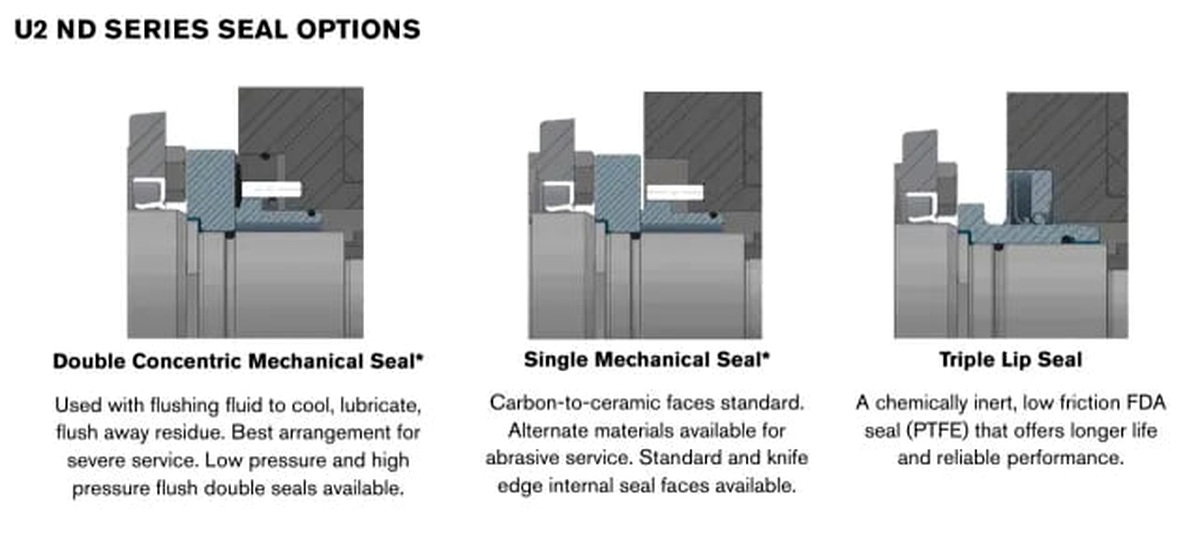
Seal selection is where a good U2 ND application either becomes reliable or becomes a maintenance routine. The right answer depends on product chemistry, temperature, viscosity, solids, lubricity, suction conditions, cleaning method, and whether the seal faces need a flush or barrier fluid.
That is why Triplex asks for the fluid details before recommending a seal plan. A pump can be mechanically correct and still fail early if the seal faces, O-rings, or elastomers are wrong for the service.
Best starting point for clean, compatible, lubricating fluids with stable suction conditions. Simple, serviceable, and often right when the product is not crystallizing, abrasive, or prone to drying at the faces.
Used when the product needs isolation, cooling, or a flush/barrier fluid. This is the conversation for sticky, crystallizing, abrasive, hot, or chemically aggressive service.
A practical option for certain industrial duties where a lip-seal arrangement fits the product and operating conditions. Temperature, abrasives, and lubrication still need to be checked.

Elastomers: small part, big consequence
Elastomers are not interchangeable rubber parts. The same pump can behave very differently with Buna-N, FKM, EPDM, PTFE, FFKM, or another specialty material. Temperature, concentration, cleaning chemistry, and exposure time all matter.
Common general-purpose option for many oils, water-based fluids, and mild industrial services.
Often considered for broader chemical and temperature resistance, but compatibility still needs confirmation.
Useful in many water, steam, and selected chemical services; usually a poor choice around many oils.
Used when chemistry, temperature, or risk justifies a more specialized material.
Use the Triplex Chemical Compatibility Guide early, then send the exact fluid, concentration, temperature, and cleaning method through the Pump Application Datasheet so the final recommendation is based on the actual service.
Four U2 ND sizing questions before anyone picks a model number
Before final selection, complete the Pump Application Datasheet. Then tighten the assumptions where mistakes usually hide: run the Friction Loss Calculator if line loss could consume the pressure budget, use the Viscosity Reference Guide to define viscosity at pumping temperature, and check the Chemical Compatibility Guide before wetted materials, O-rings, or seal faces are treated as interchangeable.
| Question | Why it changes the pump |
|---|---|
| What flow rate do you need? | Flow is tied to displacement and speed. Overspeeding an abrasive or shear-sensitive product creates new problems. |
| What differential pressure will the pump see? | Pressure affects horsepower, shaft loading, seal selection, and model suitability. |
| What is the viscosity at actual pumping temperature? | Viscosity changes slip, suction limits, horsepower, and allowable speed. |
| What can go wrong in the process? | Dry-run events, temperature swings, solids settling, valve closures, and poor suction conditions all change the configuration. |
The published U2 ND range is broad, but broad range does not replace sizing. It gives us room to choose the right displacement, speed, seals, clearances, and drive package.
Maintenance: what to watch
Good maintenance starts with a pump that was configured correctly. If an abrasive slurry is running too fast, maintenance becomes a scheduled apology. If a chemical attacks the O-ring, the seal did not “fail early” — the material selection failed early. If a pump starves on suction, the rotor chamber is being asked to solve a piping problem.
For the U2 ND, the maintenance conversation usually centers on seal kits, O-rings, rotor condition, clearances, bearing health, and the speed the pump is being asked to run. Triplex can help cross-reference parts, review a nameplate, and decide whether the pump is being operated in a reasonable window.
Bottom line
The Universal 2 ND is not interesting because it is new. It is interesting because it puts the Waukesha Universal pumping architecture into an industrial package that is easier to justify for industrial duty. The engineering only matters if it solves the plant’s actual problem: moving a difficult fluid reliably, cleanly, and with fewer surprises.
U2 ND FAQs
How do ECP rotors move fluid?
External circumferential piston rotors open cavities at the inlet, carry product around the casing, maintain clearance through timing gears, and discharge a controlled volume each revolution.
Which U2 ND seal options should be reviewed?
Common U2 ND seal discussions include single mechanical seals, double concentric mechanical seals, and triple lip seals. The right choice depends on chemistry, temperature, solids, lubricity, dry-run risk, and whether a flush or barrier fluid is needed.
What sizing questions matter most?
Start with flow rate, differential pressure, viscosity at pumping temperature, suction conditions, product chemistry, solids or abrasives, temperature, and the process upset conditions the pump may see.
Bring us the application. We’ll bring the pump questions.
Send the flow, pressure, viscosity, temperature, fluid chemistry, and current pump details. Triplex Sales will help determine whether the U2 ND is the right platform and how it should be configured.

