Building the Plant-Floor Ontology: What a Triplex Audit Actually Captures

In Part 1, we introduced the concept of stateless maintenance — every failure starts from zero because the plant has no persistent, connected record of its installed equipment.
The question is how you build one.
The answer is not a software platform. It is not a CMMS migration project or a digital twin initiative. It is a disciplined walkdown of your plant floor, documented in a format that maintenance, purchasing, and your support partner can actually reach for when something goes wrong.
This is what Triplex calls an installed-base audit. Understanding what it captures — and why the structure of the output matters — is understanding how the memory layer gets built.
Objects, Properties, and Relationships
An operational ontology is built around a simple model: the world is made of objects. Objects have properties. Objects have relationships to other objects. Document all three — consistently, in a connected format — and you have something you can act on.
The plant floor works on the same model. The objects are your equipment: the lobe pump on Line 3, the diaphragm valve bank in the CIP room, the high-pressure homogenizer in the emulsification suite. Each has properties — manufacturer, model, serial number, location, application, configuration. And each has relationships — to the wear items it consumes, the spare parts it requires, the supplier that supports it, the service history that explains how it behaves.
A Triplex audit populates that model systematically. Here is what gets captured:
Equipment objects. Manufacturer, product family, model, and serial number where accessible. For sanitary and process equipment — pumps, valves, seals, homogenizers, heat exchangers, CIP components — the manufacturer and model define the entire downstream support path. Two pumps that look identical on the floor can require completely different seal kits, impeller dimensions, and service procedures.
Application and location context. Where is the equipment installed, and what is it doing? A lobe pump in a filling line and the same model in a CIP return circuit have different wear patterns, service intervals, and criticality. Context transforms an equipment record from a catalog entry into an operational reference.
Condition and service notes. Observations from the walkdown: a valve stem showing leakage at the packing, a pump running louder than it should, a heat exchanger the maintenance crew has flagged for next shutdown. Not a formal condition assessment — the kind of observation a field technician makes when they are paying attention and have somewhere useful to write it down.
Wear items and spare relationships. For each equipment family, Triplex identifies the parts most frequently needed: seal kits, gaskets, wear plates, piston rod packings, actuator trim, diaphragms. These become the edges of the graph — connecting an equipment object to the parts it consumes and the suppliers who provide them.
Reorder and support path. For the manufacturer lines Triplex represents and supports, the supply relationship is mapped as part of the record. When maintenance needs to reorder, the path is documented — not reconstructed from a ten-year-old email thread.
How Triplex Runs the Audit
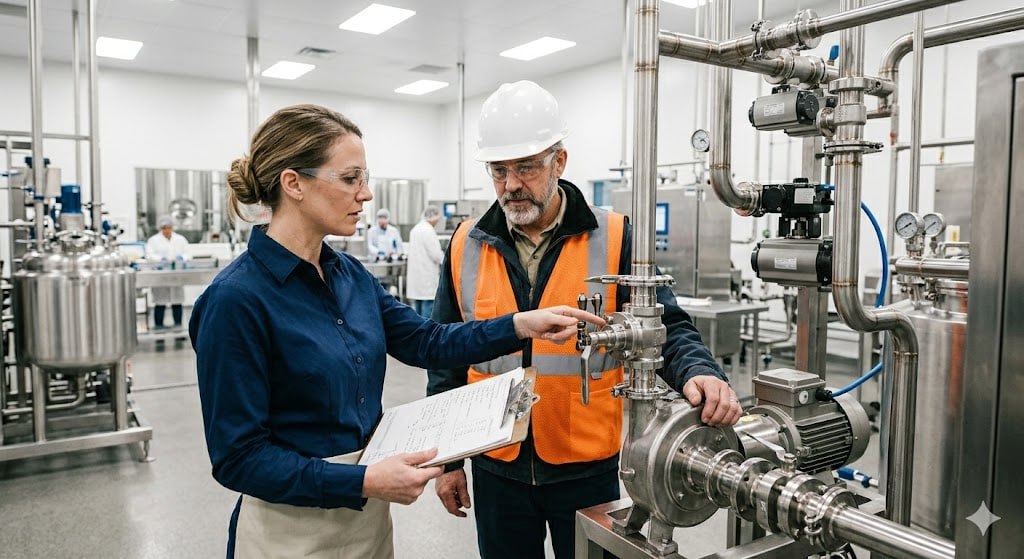
A Triplex audit starts with a facility walkdown — typically conducted alongside a maintenance manager, reliability engineer, or lead tech who knows the equipment. The walkdown captures every equipment family the plant runs that falls within Triplex’s support scope: sanitary pumps, valves, seals, homogenizers, heat exchangers, CIP components, and related process equipment.
The output is a structured workbook organized by line, location, and application — with manufacturer and model cross-referenced to Triplex’s support capabilities. Triplex then uses that workbook as the foundation for three follow-up actions:
- Recommended spares list — organized by equipment and criticality
- VMI / replenishment candidates — items with predictable demand patterns
- Flagged follow-up items — equipment needing quotes, service, or priority attention
The workbook stays with the customer. Triplex maintains a parallel record that drives ongoing support — so every future interaction starts from existing context rather than from zero.
The Installed Base That Keeps Appearing

Across Triplex audits in food and beverage, sanitary process, pharmaceutical, and chemical facilities, one equipment pattern appears with striking consistency: dense concentrations of SPX / Waukesha / APV / WCB sanitary equipment. In audit after audit, this manufacturer family accounts for close to half of all documented equipment rows.
These families have been embedded in processing facilities for decades. They run reliably, get maintained in place, get replaced in-kind, and new installations grow around the existing base. That density matters for the ontology: once a plant’s Waukesha/APV/WCB footprint is mapped, the spare-parts logic and service knowledge applies across most of the facility’s critical process equipment. The ontology is highly reusable.
Why Format Is as Important as Data
An ontology is only useful if it can be queried and acted on. For the plant floor, that means something simpler than enterprise software: a structured workbook that maintenance and purchasing can open, search, and hand to a vendor without explanation.
What it is not: a proprietary platform requiring a license. What it is: a working document your team can update as equipment changes, share across shifts, and hand to a new maintenance manager without a knowledge-transfer session.
The value shows up most clearly under pressure. Instead of starting from scratch when a pump fails, you start from a record that has already answered the manufacturer, model, configuration, and seal-material questions. The detective work is done before the emergency.
A Triplex installed-base audit builds the plant-floor ontology by documenting equipment objects, their properties, and their relationships to wear items, spare parts, and support paths — then using that record as the active foundation for spares planning, VMI, and service support.
Want to see what the ontology looks like for your facility?

