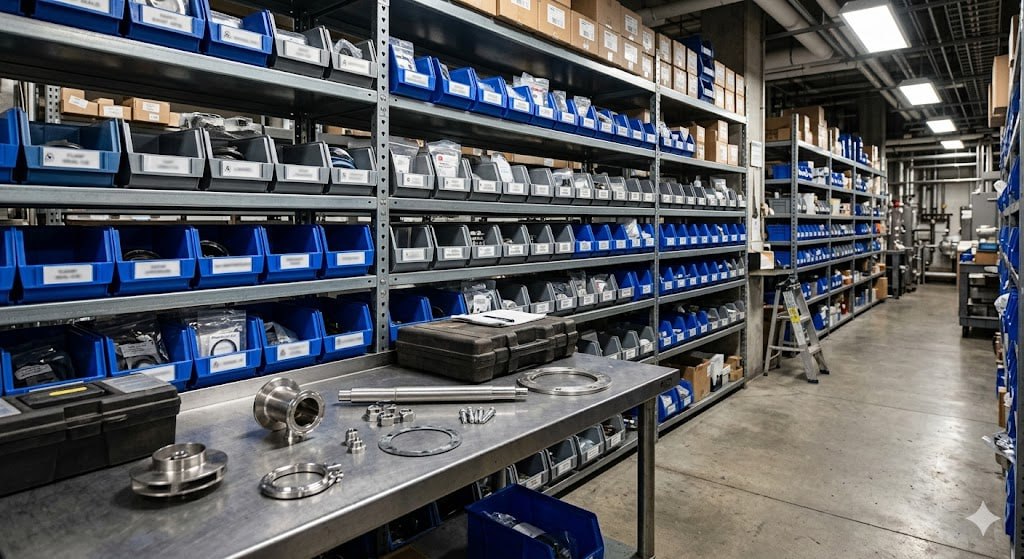
When the Memory Layer Goes Operational: Spares, VMI, and the Ontology in Action

In Parts 1 and 2, we introduced the plant-floor ontology — a connected, persistent memory layer built from documented equipment objects, their properties, and their relationships to parts, suppliers, and service paths.
The audit builds that ontology. But an ontology that lives in a workbook and never drives action is just a more organized version of the binder problem it replaced.
The value of the memory layer is realized when it goes operational: when documented equipment becomes the basis for spares decisions, replenishment programs, quote follow-up, and service planning. When the relationships between objects — equipment to wear items, wear items to reorder paths, reorder paths to Triplex — actually get used.
Querying the Ontology: Recommended Spares
An ontology becomes valuable when it can be queried — when you can ask questions of the connected record and get answers that drive decisions. For the plant-floor ontology, the first operational query is the most urgent: if this equipment goes down tonight, what do I need on the shelf?
The audit record answers that question because it has already mapped the relationships. For a sanitary pump, the answer is not just “seal kit” — it is the specific elastomer for the product chemistry and CIP cycle, the correct impeller configuration, and the back-up wear components that take weeks to expedite if ordered reactively. For a diaphragm valve bank, it is the right diaphragm material by application and the actuator trim matched to the installed configuration.
Triplex builds recommended spares lists directly from the audit record — organized by equipment object, prioritized by criticality and failure risk, and matched to the support path already documented in the workbook.
The goal is to shift the spares decision from reactive (after a failure, under pressure, with limited options) to proactive (during a procurement cycle or budget conversation, with time to choose correctly). Triplex works through the list with the maintenance and purchasing teams, flags the highest-priority items, and supports stocking decisions with supplier lead times and pricing.
The VMI Layer: Operationalizing Replenishment
For equipment with consistent, predictable demand — seal kits replaced on a known cadence, gasket sets consumed at a measurable rate — the ontology supports a higher level of operational structure: vendor-managed inventory.

Triplex VMI programs are organized directly from the installed-base record. The logic is straightforward: the audit identifies that a facility runs a specific pump type across multiple production lines, consuming a particular seal kit at a predictable rate. That equipment object and its consumption relationship become the basis for a min/max replenishment program — agreed stocking levels, reorder triggers, and a supply path through Triplex that keeps critical spares available without requiring a manual purchase order every time.
This is not a software platform or automated fulfillment service. It is a documented replenishment program organized around real equipment and real consumption patterns — with Triplex as the memory layer that knows what the facility runs, what it consumes, and when replenishment is due.
Across active Triplex VMI programs, post-audit replenishment activity has concentrated consistently around the equipment families and repeat-risk parts identified during the walkdown — the pattern you would expect when a supply program is organized around a real equipment ontology rather than reactive demand signals.
Service Dispatch and Shutdown Planning
The ontology also surfaces the objects that need attention beyond a spare part: equipment running outside normal condition, systems flagged during the walkdown, items that need service scheduling before the next planned shutdown.
Because the context is already documented — equipment object, application, observed condition, service history — the path from observation to quote to scheduled service is shorter. There is no need to re-establish context with every service conversation. The memory layer carries it.
For pharma, food and beverage, and sanitary process facilities managing planned shutdown windows, this matters operationally. Repairs need to be coordinated. Parts need to be staged. Service windows are fixed. A connected equipment record that maps what needs attention — against lead times and service availability — is a meaningful advantage over a scattered set of individual conversations starting from scratch.
What Keeps the Memory Layer Alive
An ontology is not a one-time artifact. Value increases as the model stays current — as objects get updated, relationships get refined, and new equipment gets added to the record.
Equipment changes. New installations get commissioned. Old equipment gets replaced with different configurations. Seal materials change as product formulations change. A record that was accurate two years ago and has never been updated is only marginally better than no record at all.
Triplex treats the audit workbook as a living reference — not a snapshot. The record gets updated as equipment changes, revisited when new equipment is commissioned, and extended as new relationships are mapped. Each service call, each order, each site visit adds context back to the memory layer.
This is what separates Triplex from a standard catalog distributor: the relationship is organized around what the plant actually runs. Every future interaction starts from accumulated context rather than from zero.
Triplex as the Memory Layer
The core argument of this series is that the plant floor needs what the most effective operational organizations have: a connected, persistent, operational model of the equipment it runs on — and a support partner committed to building and maintaining it.
That does not require an enterprise software contract or a multiyear implementation. It requires a disciplined partner who will walk your floor, document what is there, map the relationships that matter, and maintain that record as the basis for every future parts, VMI, and service interaction.
That is what Triplex offers. Not just parts and service. The memory layer that makes every future interaction faster, more targeted, and more useful than the last.
The plant-floor ontology becomes operationally valuable when it drives spares planning, VMI replenishment, and service follow-up. Triplex’s role is not just to supply parts — it is to build and maintain the memory layer that makes every future maintenance interaction faster and better-informed than the last.
Ready to build the memory layer for your facility’s equipment?

