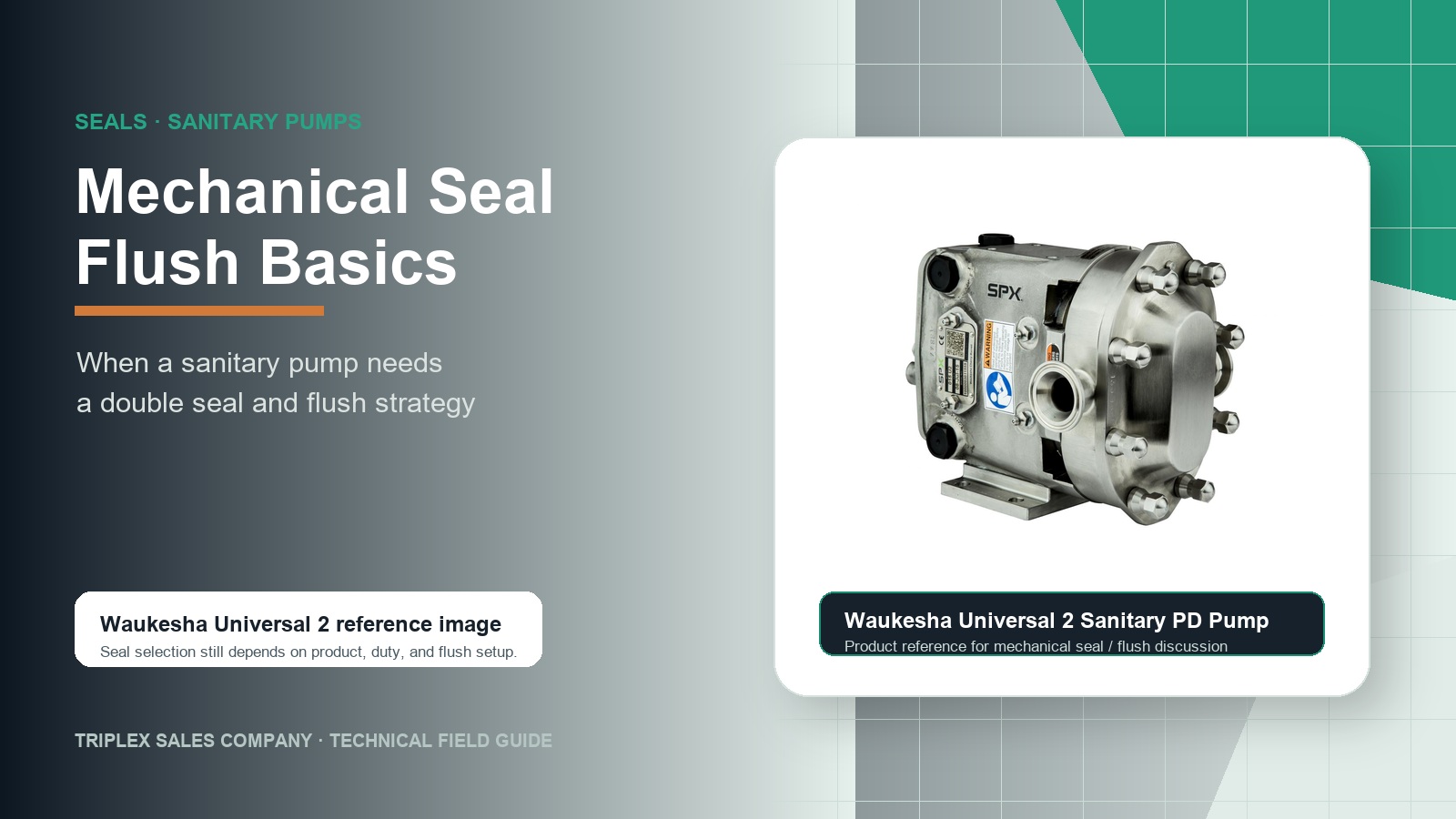
Mechanical Seal Flush Basics: When a Sanitary Pump Needs a Double Seal
A practical guide to cooling, cleaning, and containment around sanitary pump seal faces.

Hot, sticky, abrasive, crystallizing, or difficult-to-contain products.
A controlled flush/barrier zone is added between inboard and outboard seal faces.
A “same as last time” seal choice can preserve the same failure mode.
A flush is not a decorative option on a sanitary pump. In the right application, it is the difference between a seal that survives the process and a seal that spends its life fighting heat, buildup, abrasion, or containment risk.
The question is practical: when does a pump need more than a single seal? The answer usually starts with the product and the operating conditions — not the pump model alone.
If the product is hot, sticky, abrasive, hazardous, prone to crystallizing, or difficult to clean from the seal area, the seal arrangement deserves a real review before quoting.
What the flush is actually doing
Cooling the faces
Seal faces generate heat. Flush flow helps carry heat away from the interface before wear accelerates.
Cleaning the seal area
Sticky, coating, or crystallizing products can build up around the seal faces. Flush flow helps rinse that zone.
Reducing abrasive damage
Suspended solids can turn the seal area into a grinding surface if they are allowed to settle.
Supporting containment
For difficult or hazardous fluids, a double seal and barrier strategy can help keep product from reaching atmosphere.
Single seal vs. double mechanical seal
A single mechanical seal has one primary sealing interface. A double mechanical seal adds a second interface, creating a controlled space where cooling, cleaning, lubrication, or containment can be engineered into the application.

What Triplex needs to check before selection
| Input | Why it matters |
|---|---|
| Product and concentration | Determines seal face, elastomer, and flush compatibility. |
| Temperature and pressure | Drives seal loading, heat generation, and flush requirements. |
| Viscosity and solids | Identifies buildup, cleaning, and abrasive-wear risk. |
| CIP method | Confirms whether the seal area is cleaned adequately during normal cycles. |
| Current failure mode | Leaking, overheating, cracking, or buildup point to different root causes. |
Need help reviewing a seal application?
Send the pump model, product, temperature, pressure, viscosity, cleaning method, and current failure mode. Triplex can help narrow whether a single seal, double seal, or flushed arrangement makes sense.
- Product and concentration
- Operating temperature and pressure
- Current seal type and failure symptom
- CIP/flush availability and utility constraints
Talk to a Triplex Sales Engineer
Draft note: verify final seal selection against current SPX/Waukesha documentation before quoting.

