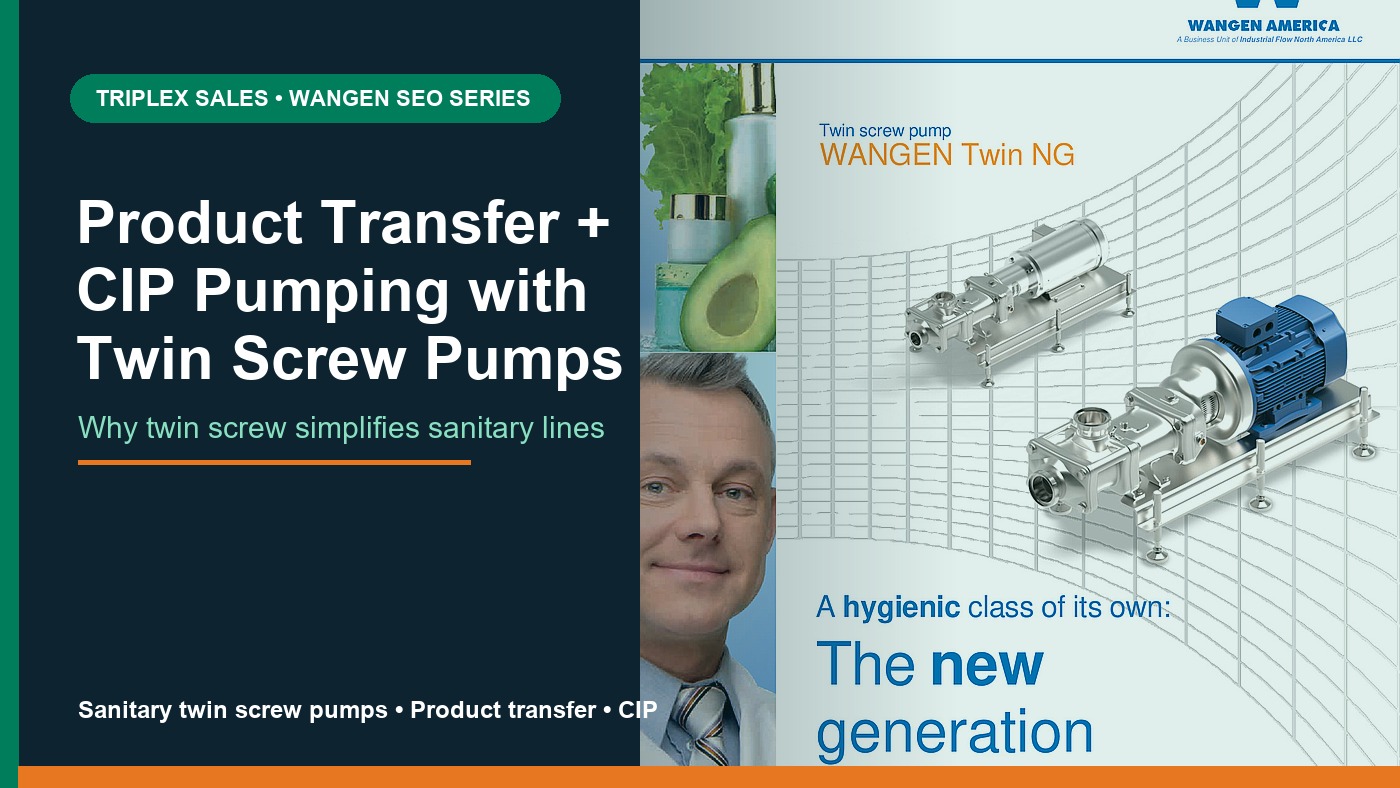
Product transfer + CIP pumping: why twin screw pumps simplify sanitary lines
A sanitary process line often has two personalities. During production, the pump needs to protect product quality. During CIP, the same line needs cleaning velocity. A WANGEN Twin NG twin screw pump can help bridge those two requirements when the system is designed correctly.

The traditional problem: one process, two pump duties
If your line is using one pump for product transfer and another for CIP, this is the place to pause before adding more hardware. Map the product duty, cleaning flow target, line size, pressure drop, and control requirements first ? then ask whether a WANGEN Twin NG twin screw pump can simplify the circuit without compromising product quality or cleaning performance.
Twin screw pumps are attractive because they can operate across a broader speed and viscosity range than many sanitary pump options. They can transfer viscous product at lower speeds, then move cleaning solution at higher speeds when the cleaning circuit supports that approach.
Where the layout can get simpler
What has to be checked before making that promise
The key phrase is “in the right system.” CIP effectiveness depends on flow velocity, line size, circuit length, restrictions, temperature, chemistry, and plant cleaning standards. A twin screw pump can be part of a simplified system, but it cannot fix an undersized line or a poorly defined cleaning requirement.
Before assuming one pump can do both jobs, Triplex will look at production flow, cleaning flow, viscosity at process temperature, required differential pressure, suction conditions, seal plan, elastomer compatibility, and whether the process sees air, foam, particles, or dry-running risk.
When a separate CIP pump may still make sense
There are cases where keeping a dedicated CIP pump is the right call. Very large cleaning circuits, plant-standard CIP skids, long headers, high cleaning velocities, or multiple simultaneous circuits may still point toward a separate cleaning pump. The goal is not to force one-pump thinking. The goal is to avoid extra equipment when the process does not need it.
Where WANGEN Twin NG fits
The WANGEN Twin NG page covers the product-transfer plus CIP story, model range, service features, VarioTwin forced-feed context, and downloadable references. It is the landing page to use when the buying question is specifically WANGEN sanitary twin screw performance.
For broader pump selection, start with the Triplex pump overview. For category-level comparison, use the twin screw overview.
Product transfer + CIP FAQs
Why use the same pump for product transfer and CIP?
Using one pump platform can reduce equipment count, simplify piping, and keep cleaning media moving through the same production path. The design still has to meet the plant’s cleaning velocity and validation requirements.
Does product viscosity affect CIP pump selection?
Yes. Product viscosity affects production transfer, pump speed, suction conditions, and line losses. CIP is usually lower viscosity, but the pump still has to cover both ends of the duty range.
What information should I send Triplex first?
Send target flow, product viscosity, temperature, differential pressure, line size, cleaning requirement, product sensitivity, solids, and any current pump problems. That is enough to start a productive sizing conversation.
Trying to simplify a sanitary line?
Use Triplex’s friction loss calculator and viscosity guide, then send the application data. We can help determine whether WANGEN Twin NG belongs in the quote package.

