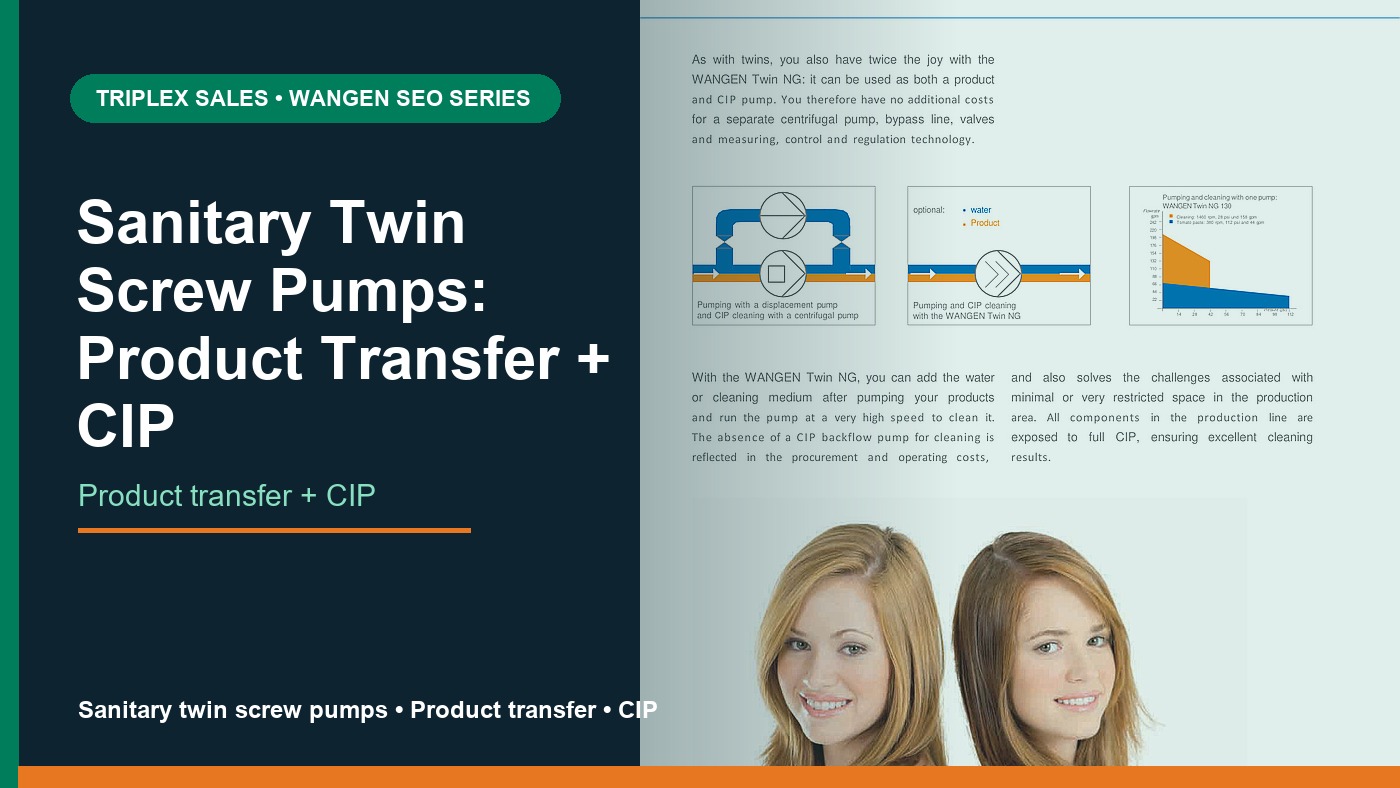
Sanitary twin screw pumps: when one pump can handle product transfer and CIP
A sanitary twin screw pump earns attention when the process asks for two very different jobs: move product gently during production, then move cleaning solution fast enough for CIP. That is exactly where the conversation around WANGEN Twin NG sanitary twin screw pumps usually starts.

Most pump selections are not just about flow rate. They are about viscosity, suction conditions, shear sensitivity, particulates, cleaning velocity, seal life, line losses, and how much hardware the plant wants to maintain. If the current layout uses one pump for product and another pump for CIP, a twin screw platform may simplify the system — provided the duty point supports it.
Why twin screw pumps are different
A sanitary twin screw pump is a positive-displacement pump with two timed screws that move product axially through the pump. The design can handle low-viscosity cleaning media and higher-viscosity product in the same hygienic platform. That is the core difference from a conventional arrangement where a lobe pump, centrifugal pump, bypass piping, and extra controls may all be part of the cleaning strategy.
When to consider a sanitary twin screw pump
Start the review when the product is too viscous, too shear-sensitive, too aerated, or too valuable for a generic pump decision. Twin screw also deserves attention when product transfer and CIP are fighting each other: one condition wants slow, careful handling; the other wants higher velocity and a cleanable circuit.
Applications often include dairy, confectionery, prepared foods, beverages with particulates, cosmetics, personal care products, and other hygienic products where texture, appearance, yield, or cleanability matter. For a broader view of the category, see Triplex’s twin screw pump overview.
What can still make the selection fail
A twin screw pump is not magic. It still needs enough suction head, the correct speed range, compatible elastomers, the right seal plan, and realistic cleaning assumptions. A system that cannot supply product to the pump inlet will not become reliable just because the pump is more capable.
Helpful tools before sizing
Use the Triplex viscosity reference guide to frame product behavior, the friction loss calculator to sanity-check piping losses, and the chemical compatibility guide to start elastomer and seal conversations. For quoting, the Pump Application Datasheet is the cleanest way to give Triplex the data needed for a real recommendation.
Sanitary twin screw pump FAQs
Can one sanitary twin screw pump replace a product pump and CIP pump?
In some systems, yes. A sanitary twin screw pump can run at production speed for product transfer and higher speed for cleaning media. Final layout depends on required cleaning velocity, pipe size, circuit design, and plant standards.
Is a twin screw pump always better than a rotary lobe pump?
No. Rotary lobe pumps are still excellent for many sanitary PD duties. Twin screw becomes more interesting when product transfer and CIP capability, viscosity range, gentle handling, and simplified cleaning layouts all matter together.
When should I look specifically at WANGEN Twin NG?
Review WANGEN Twin NG when the application needs sanitary product transfer, CIP capability, low pulsation, viscosity flexibility, fast service access, and model coverage for a range of hygienic duties.
Need help deciding if twin screw belongs in the discussion?
Send Triplex the product, flow, pressure, viscosity, temperature, cleaning requirements, and current-pump problem. We will help determine whether WANGEN Twin NG, another twin screw platform, or a different pump type is the better fit.

